Introduction
A halwa making machine is a specialized piece of equipment used in commercial kitchens and food manufacturing units to prepare halwa efficiently, hygienically, and in large quantities. Halwa is a traditional sweet that requires continuous heating, precise mixing, and constant stirring to achieve the right texture and flavor. When prepared manually, this process is labor-intensive, time-consuming, and physically demanding, especially for bulk production.
In modern sweet manufacturing, consistency and hygiene are as important as taste. A halwa making machine automates the cooking and mixing process, ensuring uniform quality in every batch while reducing manual effort. These machines are widely used in sweet shops, hotels, catering units, temples, and food processing industries where large-scale halwa production is required.
Chandran Steels manufactures robust and food-grade halwa making machines designed to meet commercial production needs. Built using high-quality stainless steel, these machines support efficient sweet preparation while maintaining hygiene standards and operational reliability. Understanding what a halwa making machine is and how it works helps food businesses choose the right equipment for consistent and scalable production.
What Is a Halwa Making Machine?
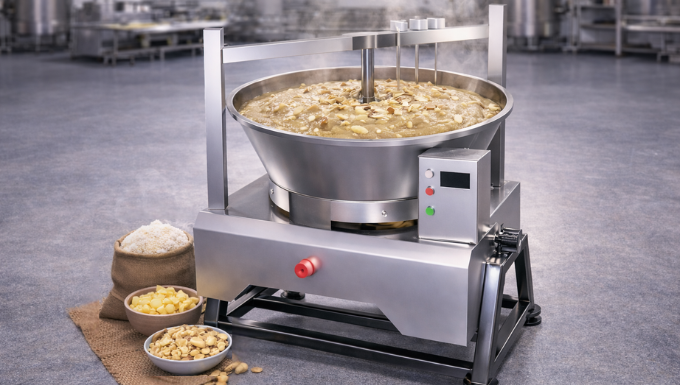
A halwa making machine is a commercial cooking and mixing unit designed specifically for preparing halwa in bulk quantities. It combines controlled heating with continuous mechanical mixing to cook ingredients evenly without burning or sticking. The machine is capable of handling thick and heavy mixtures that require constant movement during cooking.
The structure of a halwa making machine typically includes a stainless steel cooking vessel, a heavy-duty mixing system, heating elements or gas burners, and a discharge mechanism. The machine is engineered to withstand high temperatures and continuous operation, making it suitable for commercial environments.
Unlike traditional cooking vessels, a halwa making machine maintains uniform heat distribution throughout the mixture. This ensures that ingredients such as flour, sugar syrup, ghee, and flavoring agents are cooked evenly. The automated mixing system prevents lump formation and eliminates the need for continuous manual stirring.
These machines are available in different capacities, allowing businesses to choose based on their production requirements. From small sweet shops to large food manufacturing units, a halwa making machine plays a crucial role in improving productivity, consistency, and hygiene in sweet preparation.
How Does a Halwa Making Machine Work?
The working process of a halwa making machine is designed to simplify and standardize halwa preparation. The process begins by loading measured ingredients into the cooking vessel. Once the ingredients are added, the heating system is activated to bring the mixture to the required cooking temperature.
As the mixture heats up, the machine’s mixing blades start rotating continuously. These blades are designed to scrape the bottom and sides of the vessel, ensuring that the mixture does not stick or burn. Continuous mixing also helps distribute heat evenly throughout the mixture, which is critical for achieving the correct halwa texture.
The operator can control temperature and mixing speed using the control panel. This allows precise cooking based on the type of halwa being prepared. As cooking progresses, the mixture thickens gradually, and the machine maintains consistent movement to achieve uniform consistency.
Once the halwa reaches the desired stage, it is discharged through an outlet mechanism. This reduces handling and improves hygiene. The entire process minimizes human intervention, ensuring efficient, safe, and consistent halwa production.
Benefits of Using a Halwa Making Machine
Using a halwa making machine offers several advantages for commercial sweet production. One of the biggest benefits is consistency. Manual preparation often results in uneven cooking, but machines ensure uniform texture and taste in every batch.
Another important benefit is labor efficiency. Traditional halwa preparation requires continuous stirring, which is physically demanding. A halwa making machine reduces manpower requirements and operator fatigue, allowing staff to focus on supervision and quality control.
Hygiene is another major advantage. These machines are made from food-grade stainless steel and reduce direct human contact with food, helping businesses comply with food safety regulations. Easy cleaning and maintenance further support hygienic operations.